
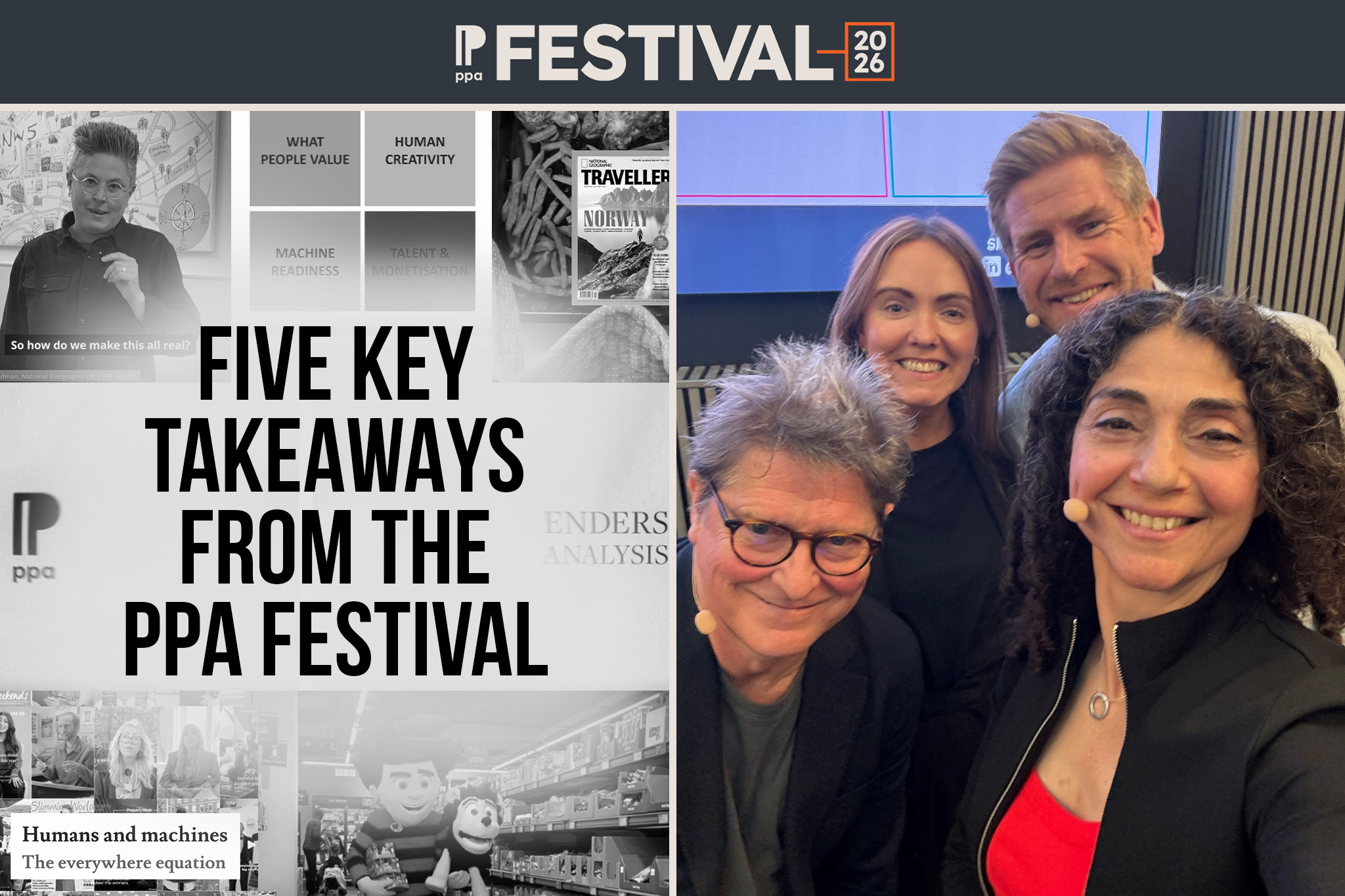
Five key takeaways from the PPA Festival: what publishers need to know now
The PPA Festival on 6 May brought together like-minded individuals to discuss what is impacting and inspiring the publishing world today. While the media landscape is evolving rapidly, the fundamentals of audience engagement remain remarkably consistent.
Across sessions covering AI, audience strategy, newsletters, creator economies and product innovation, one message came through time and again — publishers that combine trusted human expertise and creativity with experimentation and strong community-building will be best placed to thrive.
Here are five key takeaways from the event.
1. Discovery is changing — and search can no longer be relied upon alone
One of the strongest themes from the Enders Analysis report, Humans and Machines: The Everywhere Equation, was the decline of traditional search as a primary discovery tool. Audiences are increasingly finding content through newsletters, creators, events, communities, social platforms and AI-powered experiences rather than through Google alone.
Publishers are being encouraged to focus less on trying to be everywhere and more on building value in the channels and relationships they truly own. The ‘hub-and-spoke’ content model discussed throughout the festival reflected this perfectly: creating one strong core piece of content and adapting it intelligently across multiple platforms and formats.
Watch the video featuring Becky Redman, art director at National Geographic Traveller (UK) on APL Media’s LinkedIn post.
2. Human connection is becoming even more valuable in the AI era
Despite the rapid acceleration of AI tools, the festival repeatedly returned to the same idea: humans remain the moat. Whether through events, newsletters, podcasts or creator-led content, audiences are increasingly seeking trusted voices, expertise and authentic connection. Personality-led journalism and niche communities are becoming more valuable as audiences grow tired of generic, algorithm-driven experiences. As several speakers highlighted, people increasingly want to hear from people, and not faceless brands.
3. AI is accelerating experimentation — but publishers still need guardrails
AI dominated many conversations, particularly around product development, workflow transformation and audience engagement. A recurring theme was how dramatically AI is compressing the gap between ideas and execution. Teams can now prototype, test and launch products far faster than ever before. Publishers are also still navigating where AI genuinely adds value and where human editorial judgement remains essential.
Experimentation is critical — but so are governance, trust and clear editorial guardrails.
4. The creator economy is reshaping publishing models
The creator economy was another major topic throughout the festival, with publishers increasingly rethinking how they collaborate with creators while protecting long-term brand value and intellectual property. Traditional publishing models are evolving rapidly. Many publishers are now acting as talent incubators, building creator-led brands across newsletters, podcasts, video and live events. There was also strong recognition that smaller, specialist teams with deep expertise can often outperform much larger organisations with less distinct identities.
The shift towards creator-led publishing is no longer emerging, it’s here, but to be used wisely and with brand integrity in mind.
5. Quality engagement matters more than scale
Perhaps the biggest overall takeaway was the growing shift away from chasing scale for scale’s sake. Audience behaviour is fragmenting, and publishers are being forced to focus more carefully on loyalty, retention and meaningful engagement rather than vanity metrics alone. Newsletters in particular were highlighted as one of the strongest tools for building direct relationships and long-term audience habits.
The discussions reinforced an important reality for publishers: sustainable growth comes from delivering consistent value, building trust and creating experiences audiences actively choose to return to.
The Clean Data panel — featuring Maria Pieri, editorial director and COO of APL Media, Richard O’Connor, CEO of B2B Marketing, and Stephanie Cathers, global head of CRM and audience development at Time Out — echoed many of these themes, particularly the importance of trusted first-party relationships and understanding audience value beyond simple traffic numbers.
Ultimately, it showed that while the media playbook is undoubtedly changing, success will still come from combining strong editorial identity, human expertise and meaningful audience connection with the willingness to experiment and evolve.
###
About APL Media
APL Media is a multi-award-winning content marketing agency and publisher, creating high-quality print, digital and live media across the travel and lifestyle sectors since 1997. It has published National Geographic Traveller (UK) under licence from National Geographic Partners LLC since 2010, alongside brand extensions including guides, events and digital platforms. Its portfolio includes Living360, a digital lifestyle brand spanning wellness, travel, food, sustainability and culture.
APL Media delivers custom content, branded campaigns and editorial consultancy, internship schemes including Step Up and produces leading events such as the Travel Media Awards. It is also a leading reseller of advertising for national newspapers. Its trade titles include Postcards and the ASTA Worldwide Destination Guide, with content also created for national newspapers.